Short answer: to get cited in a Google AI Overview, audit your page's readiness first, add FAQ schema, answer each question directly in 40–60 words, use question-style headings, strengthen your E-E-A-T, fix Core Web Vitals, and build real topical depth. Then track it monthly. The fastest start is to check your AI Overview readiness and fix the biggest gaps first.
I optimize sites for AI search every week, and one thing is clear. Google's AI doesn't quote the page that ranks best — it quotes the page that's easiest to lift a clean answer from.
That's the mindset shift. Getting cited is less about chasing backlinks and more about formatting your answers the way an AI wants to read them. This guide walks through the exact process I use, step by step.
What does "getting cited in an AI Overview" mean?
It means your page appears as one of the source links inside Google's AI-generated answer box, which sits above the normal blue links. When you're cited, users see your brand first — often before they scroll at all.
This is the goal of Generative Engine Optimization (GEO): optimizing so AI engines quote you, not just rank you. It's the natural next step after traditional SEO.
The difference matters because the two systems pick winners differently. A page can rank first in the blue links and still be skipped by the AI if its structure and trust signals are weak.
A Google AI Overview box with its source-citation links highlighted, above the traditional results
Why does being cited matter so much?
Because the AI answer takes the clicks. When it appears, the traditional links below it get far less traffic than they used to.
The top result can lose up to 58% of its clicks when an AI Overview shows.
That figure comes from an Ahrefs study of 300,000 keywords. Google describes how the feature works in its own AI features documentation.
So being cited is the new top spot. If the AI answers the query and you're not one of its sources, you're invisible for that search — even at position one.
There's an upside, though. Being cited puts your brand name inside the answer itself, which builds trust before the click and often lifts your click-through rate on the searches where you do appear.
How do I get my site cited in AI Overviews?
Follow these seven steps in order. The first one tells you which of the rest you actually need, so you're not guessing.
- Audit your current readiness firstBefore changing anything, run your page through a free AI Overview Checker to get a GEO readiness score and a list of weak signals. This tells you where you stand and stops you wasting time on things that are already fine. Fix the biggest gaps first.
- Add FAQ schema markupStructured Q&A is one of the most-cited formats in AI answers. Generate valid JSON-LD with a schema markup generator and add four to six real questions your readers ask. Schema is machine-readable, so it removes the guesswork for the AI.
- Answer the question in the first 40–60 wordsLead each section with a short, direct answer, then expand below it. AI systems extract concise answers, so front-load the payoff instead of burying it under a long intro.
- Use question-based headingsTurn your H2s and H3s into the exact questions people search — "What is X?", "How does X work?", "Why does X matter?" This maps your content to real queries and makes each section easy to quote in isolation.
- Strengthen your E-E-A-TAdd a real author bio with credentials, clear publication and update dates, and external citations to authoritative sources. In AI search these trust signals now carry more weight than raw backlink counts.
- Fix your Core Web VitalsSlow or unstable pages get skipped before the content is even judged. Check your LCP, CLS, and INP with a Core Web Vitals checker and clear the red flags first.
- Go deep on the topicComprehensive pages (1,500+ words) that fully answer a topic from several angles get cited far more than thin pages. Cover the definition, the steps, the comparisons, and the common mistakes in one place so the AI has everything it needs.
Not sure where your page stands?
Get your GEO readiness score out of 100 and a prioritized fix list — free, no signup.
What content format gets cited most?
Short, self-contained answers win. The AI is looking for a passage it can lift almost word-for-word, so the more "quotable" your paragraph, the better your odds.
In my experience, three formats get pulled most often. Direct-answer paragraphs under a question heading, numbered step lists for "how to" queries, and clean comparison tables for "X vs Y" queries.
Bulleted definitions also work well for "what is" searches. The pattern is the same each time — give the answer plainly, then support it, rather than making the reader (or the AI) dig for it.
Avoid burying the point inside a long story. Keep one idea per paragraph, and make the first sentence of each section carry the answer on its own.
How do I write an answer the AI will quote?
Write the way you'd answer a smart friend who's in a hurry. Say the answer in one or two sentences, then explain.
Keep the answer between 40 and 60 words. Use plain language at a grade 7–8 reading level, because clarity is what makes a passage easy to extract.
Add one concrete detail — a number, a name, or a specific step — so the answer feels sourced rather than vague. Vague filler like "it depends on many factors" gives the AI nothing to quote.
How should I structure a whole page for GEO?
Think of the page as a stack of self-contained answers. Each section should stand on its own, so the AI can lift it without needing the rest of the page.
Open with a short summary that answers the main query in the first 100 words. This is your snippet bait, and it's often the exact passage that gets pulled into the overview.
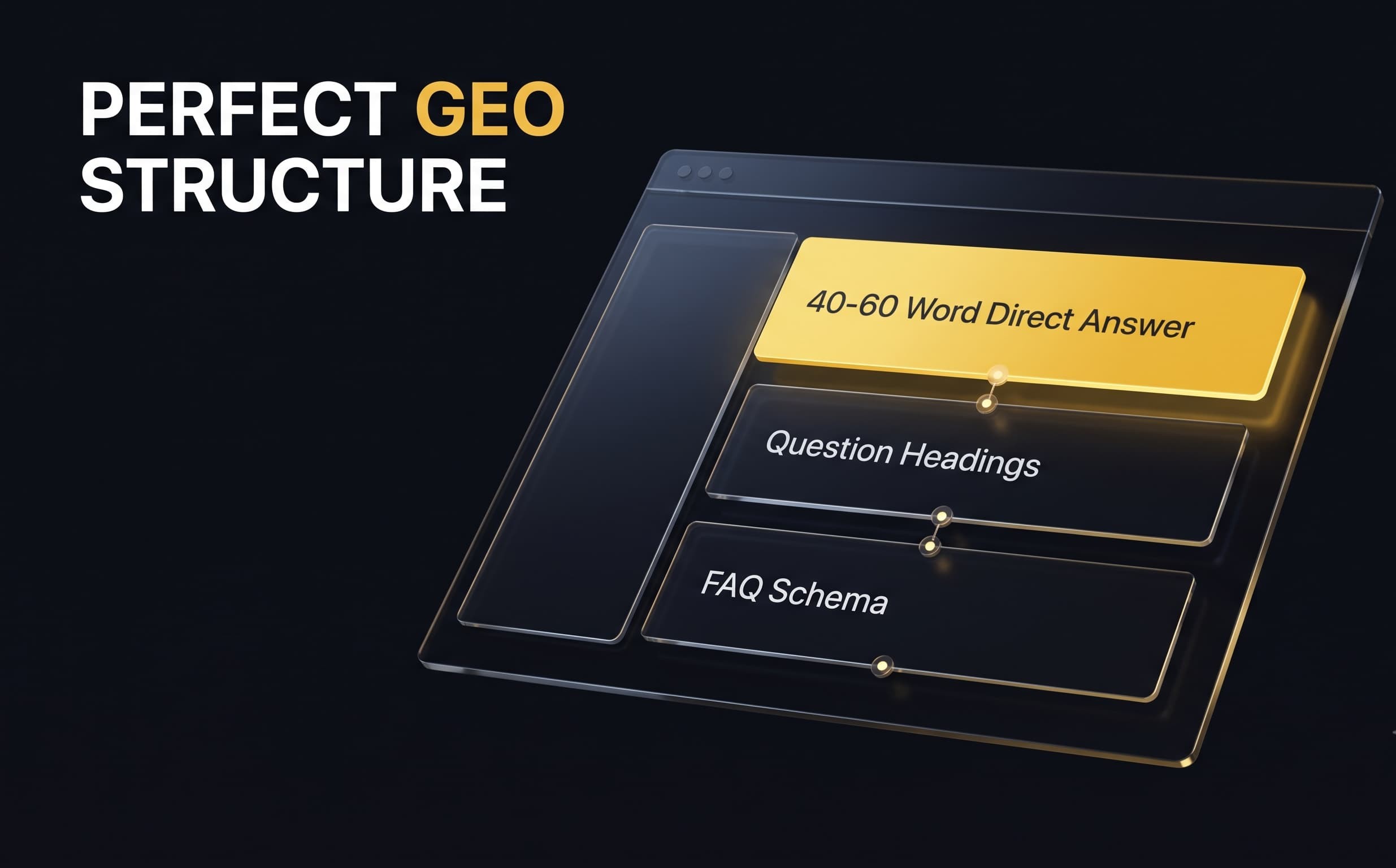
Then break the topic into question-based sections, each starting with a direct 40–60 word answer. Add one list or table where it fits naturally, since those formats get cited often.
Group related questions together so the flow matches how people actually think through the topic. Close with an FAQ that targets the "People also ask" questions, and mark it up with FAQ schema so each question is machine-readable.
Finally, add clear author and date signals, and keep the page fast and clean. If you're not sure your structure passes, run it through a free GEO readiness score check before publishing and fix whatever it flags.
What mistakes stop pages from getting cited?
Most pages fail for the same handful of reasons. Fixing these usually moves the needle faster than writing new content.
The first is no schema. Without structured data, the AI has to guess what your page is about, and it often guesses wrong.
The second is answers buried deep in the page. If the payoff is in paragraph six, the AI may never reach it. The third is weak author signals — no bio, no dates, no citations — which reads as low trust.
The last one is chasing the wrong query. If your page has no real chance of being cited for a broad, competitive term, target the specific question you can actually answer best.
How long until you get cited?
Usually a few weeks after Google recrawls and re-evaluates your page. Schema and formatting changes tend to get picked up faster than authority changes, which build over time.
Be patient and consistent. Citations also rotate — a page cited this week may drop next week and return later — so don't panic at normal movement.
The pages that hold their citations are the ones that stay genuinely useful and get small, steady updates rather than being rewritten every month.
How do I know if it worked?
Check monthly. Run your target keyword through a live checker to see if an AI Overview appears and whether you're one of its sources, then re-run the free AI Overview Checker to confirm your readiness score climbed.
Watch your impressions in Search Console too. A rise in impressions with steady rankings is often the first sign the AI is surfacing your page.
If you want a full list of tools for this, I compared them in my guide to the best free AI Overview checkers.